



- GBP/USD clings to marginal gains in the European session on Tuesday.
- The risk-averse market atmosphere limits the pair’s upside.
- US politics are likely to continue to influence the USD’s valuation.
After closing with small gains on Monday, GBP/USD holds its ground and trades slightly below 1.3450 in the European session on Tuesday. Markets cling to a cautious stance as investors grow increasingly concerned over a possible government shutdown in the US.
Pound Sterling Price This week
The table below shows the percentage change of British Pound (GBP) against listed major currencies this week. British Pound was the strongest against the US Dollar.
| USD | EUR | GBP | JPY | CAD | AUD | NZD | CHF | |
|---|---|---|---|---|---|---|---|---|
| USD | -0.36% | -0.33% | -1.01% | -0.14% | -0.91% | -0.12% | -0.02% | |
| EUR | 0.36% | 0.03% | -0.82% | 0.22% | -0.55% | 0.23% | 0.32% | |
| GBP | 0.33% | -0.03% | -0.76% | 0.19% | -0.63% | 0.20% | 0.30% | |
| JPY | 1.01% | 0.82% | 0.76% | 0.91% | 0.14% | 0.78% | 1.05% | |
| CAD | 0.14% | -0.22% | -0.19% | -0.91% | -0.73% | 0.02% | 0.11% | |
| AUD | 0.91% | 0.55% | 0.63% | -0.14% | 0.73% | 0.78% | 0.88% | |
| NZD | 0.12% | -0.23% | -0.20% | -0.78% | -0.02% | -0.78% | 0.24% | |
| CHF | 0.02% | -0.32% | -0.30% | -1.05% | -0.11% | -0.88% | -0.24% |
The heat map shows percentage changes of major currencies against each other. The base currency is picked from the left column, while the quote currency is picked from the top row. For example, if you pick the British Pound from the left column and move along the horizontal line to the US Dollar, the percentage change displayed in the box will represent GBP (base)/USD (quote).
After meeting with Republicans on Monday, Senate Democratic Leader Chuck Schumer said that the two sides still have “very large differences.” Additionally, Vice President JD Vance noted that he thought they were headed to a government shutdown.
In the case of a shutdown or a partial shutdown, the September employment report, which is scheduled to be released on Friday, and other data releases from the US will be delayed. This uncertainty seems to be making it difficult for the USD to find demand.
Early Tuesday, the UK’s Office for National Statistics (ONS) reported that it revised the annualized Gross Domestic Product (GDP) growth for the second quarter to 1.4% from 1.2% in the previous estimate.
Meanwhile, Bank of England (BoE) Deputy Governor Dave Ramsden said on Monday that Britain’s jobs market had weakened and wage growth was normalising, giving him confidence that inflation would fall back toward their target. “I see scope for further removal of policy restraint,” Ramsden added.
Although these comments could be seen negative for Pound Sterling, the selling pressure surrounding the USD helps GBP/USD keep its footing.
In the second half of the day, the US Bureau of Labor Statistics will release the JOLTS Job Openings data for August. A noticeable increase, with a reading at or above 7.5 million, could be supportive for the USD. However, investors could refrain from betting on a steady recovery in the USD unless lawmakers manage to avoid a shutdown.
GBP/USD Technical Analysis
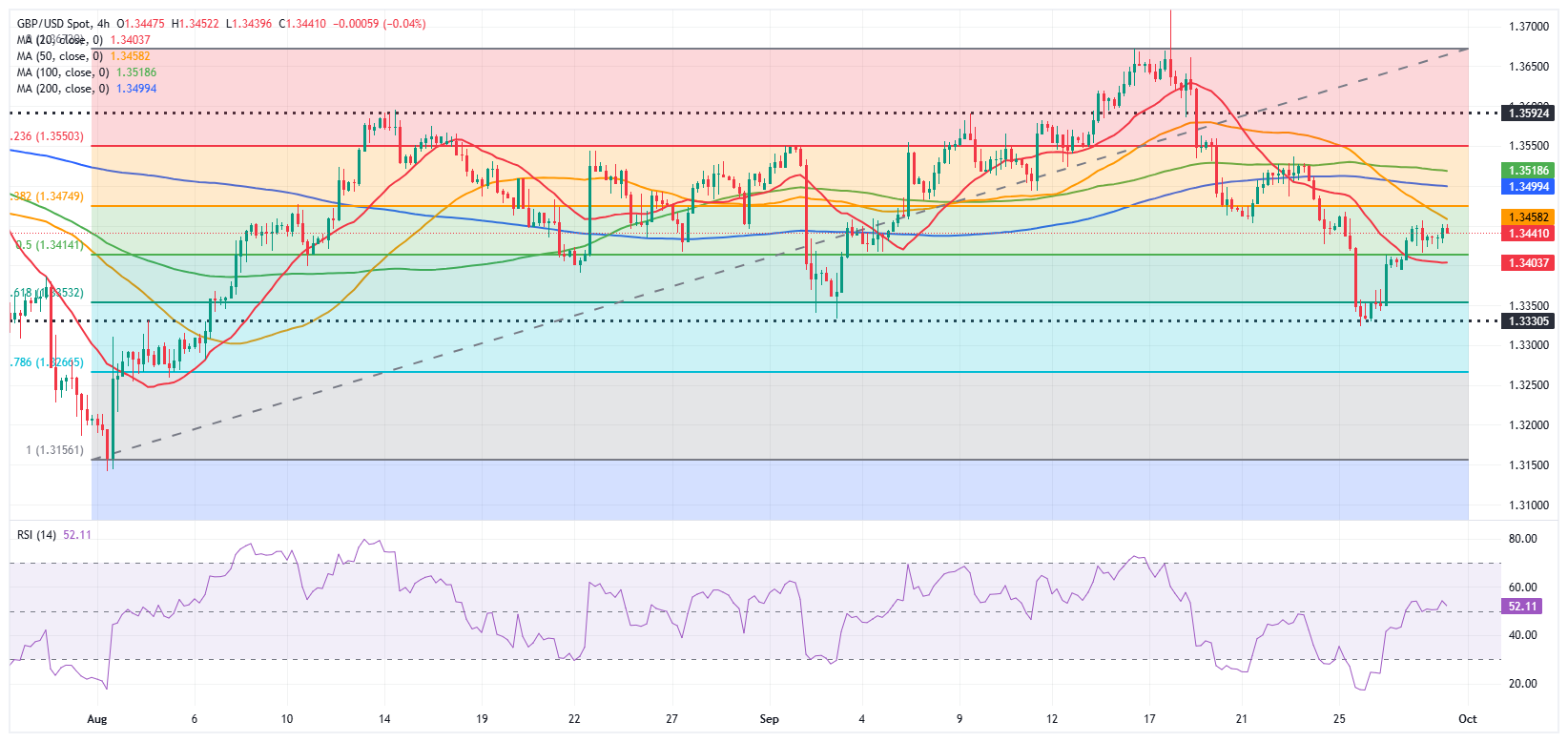
The Relative Strength Index (RSI) indicator on the 4-hour chart stays slightly above 50, while GBP/USD continues to trade below the 20-day, 50-day and 100-day Simple Moving Averages (SMAs), highlighting buyers’ hesitancy.
Looking south, support levels could be seen at 1.3410-1.3400 (Fibonacci 50% retracement of the latest uptrend, round level), 1.3330 (static level) and 1.3300 (round level). On the upside, the first resistance level aligns at 1.3470-1.3475 (50-day SMA, Fibonacci 38.2% retracement) before 1.3490-1.3500 (100-day SMA, 20-day SMA, 200-period SMA) and 1.3550 (Fibonacci 23.6% retracement).
Pound Sterling FAQs
The Pound Sterling (GBP) is the oldest currency in the world (886 AD) and the official currency of the United Kingdom. It is the fourth most traded unit for foreign exchange (FX) in the world, accounting for 12% of all transactions, averaging $630 billion a day, according to 2022 data. Its key trading pairs are GBP/USD, also known as ‘Cable’, which accounts for 11% of FX, GBP/JPY, or the ‘Dragon’ as it is known by traders (3%), and EUR/GBP (2%). The Pound Sterling is issued by the Bank of England (BoE).
The single most important factor influencing the value of the Pound Sterling is monetary policy decided by the Bank of England. The BoE bases its decisions on whether it has achieved its primary goal of “price stability” – a steady inflation rate of around 2%. Its primary tool for achieving this is the adjustment of interest rates. When inflation is too high, the BoE will try to rein it in by raising interest rates, making it more expensive for people and businesses to access credit. This is generally positive for GBP, as higher interest rates make the UK a more attractive place for global investors to park their money. When inflation falls too low it is a sign economic growth is slowing. In this scenario, the BoE will consider lowering interest rates to cheapen credit so businesses will borrow more to invest in growth-generating projects.
Data releases gauge the health of the economy and can impact the value of the Pound Sterling. Indicators such as GDP, Manufacturing and Services PMIs, and employment can all influence the direction of the GBP. A strong economy is good for Sterling. Not only does it attract more foreign investment but it may encourage the BoE to put up interest rates, which will directly strengthen GBP. Otherwise, if economic data is weak, the Pound Sterling is likely to fall.
Another significant data release for the Pound Sterling is the Trade Balance. This indicator measures the difference between what a country earns from its exports and what it spends on imports over a given period. If a country produces highly sought-after exports, its currency will benefit purely from the extra demand created from foreign buyers seeking to purchase these goods. Therefore, a positive net Trade Balance strengthens a currency and vice versa for a negative balance.
Information on these pages contains forward-looking statements that involve risks and uncertainties. Markets and instruments profiled on this page are for informational purposes only and should not in any way come across as a recommendation to buy or sell in these assets. You should do your own thorough research before making any investment decisions. FXStreet does not in any way guarantee that this information is free from mistakes, errors, or material misstatements. It also does not guarantee that this information is of a timely nature. Investing in Open Markets involves a great deal of risk, including the loss of all or a portion of your investment, as well as emotional distress. All risks, losses and costs associated with investing, including total loss of principal, are your responsibility. The views and opinions expressed in this article are those of the authors and do not necessarily reflect the official policy or position of FXStreet nor its advertisers. The author will not be held responsible for information that is found at the end of links posted on this page.
If not otherwise explicitly mentioned in the body of the article, at the time of writing, the author has no position in any stock mentioned in this article and no business relationship with any company mentioned. The author has not received compensation for writing this article, other than from FXStreet.
FXStreet and the author do not provide personalized recommendations. The author makes no representations as to the accuracy, completeness, or suitability of this information. FXStreet and the author will not be liable for any errors, omissions or any losses, injuries or damages arising from this information and its display or use. Errors and omissions excepted.
The author and FXStreet are not registered investment advisors and nothing in this article is intended to be investment advice.