

The Japanese Yen (JPY) prolongs the downtrend for the seventh straight day against its American counterpart amid expectations that Japan’s new Prime Minister Sanae Takaichi will pursue expansionary spending policies and resist early tightening. Apart from this, signs of easing US-China trade tensions turn out to be another factor denting demand for the safe-haven JPY, lifting the USD/JPY pair to an over two-week high, closer to the 153.25-153.30 supply zone, during the Asian session on Monday.
Meanwhile, data released earlier today showed that Japan’s service-sector inflation rose again in September and reinforced bets for an imminent rate hike by the Bank of Japan’s (BoJ). This marks a significant divergence in comparison to dovish Federal Reserve (Fed) expectations, which, in turn, could support to the lower-yielding JPY and cap the USD/JPY pair. Traders might also opt to move to the sidelines ahead of the crucial Fed decision on Wednesday and the BoJ policy update on Thursday.
Japanese Yen struggles to lure buyers despite BoJ rate hike bets
- Data released earlier this Monday showed that Japan’s Services Producer Price index perked up for the second straight month in September and accelerated to 3.0% from a 2.7% gain in August. With consumer inflation in Japan exceeding the Bank of Japan’s 2% target for well over three years, the latest figures back the case for further policy tightening by the central bank, though it does little to boost the Japanese Yen.
- Japan’s new Prime Minister Sanae Takaichi, a fiscal and monetary dove, is seen as the successor of the former Premier Shinzo Abe’s economic policies and is known for her pro-stimulus stance. This has been fueling concerns about Japan’s fiscal health and clouds the outlook for further BoJ policy tightening, which, in turn, is holding back the JPY bulls from placing aggressive bets and keep a lid on further gains.
- The US Bureau of Labor Statistics reported on Friday that the headline Consumer Price Index rose by 0.3% in September, putting the annual inflation rate at 3%. Excluding food and energy, the gauge showed a 0.2% monthly gain and an annual rate stood at 3%. The reading fell short of consensus estimates and reaffirmed market bets for an imminent interest rate cut by the US Federal Reserve later this week.
- Traders are also pricing in a greater chance of another rate reduction at the December FOMC policy meeting, which, in turn, fails to assist the US Dollar to capitalize on Friday’s goodish rebound from a one-week low. Moreover, the divergent BoJ-Fed policy expectations could offer some support to the lower-yielding JPY and cap the upside for the USD/JPY pair ahead of this week’s key central bank events.
- The US Fed is scheduled to announce its decision at the end of a two-day policy meeting on Wednesday, and will be followed by the BoJ policy update on Thursday. The outlooks will play a key role in determining the next leg of a directional move for the USD/JPY pair.
- On the trade-related front, top Chinese and US economic officials on Sunday have agreed on the framework of a potential trade deal that will be discussed when US President Donald Trump and Chinese President Xi Jinping meet later this week. This helps ease worries about an all-out trade war between the world’s two largest economies, which could undermine the JPY’s safe-haven status.
USD/JPY could accelerate positive move above the 153.25-153.30 hurdle
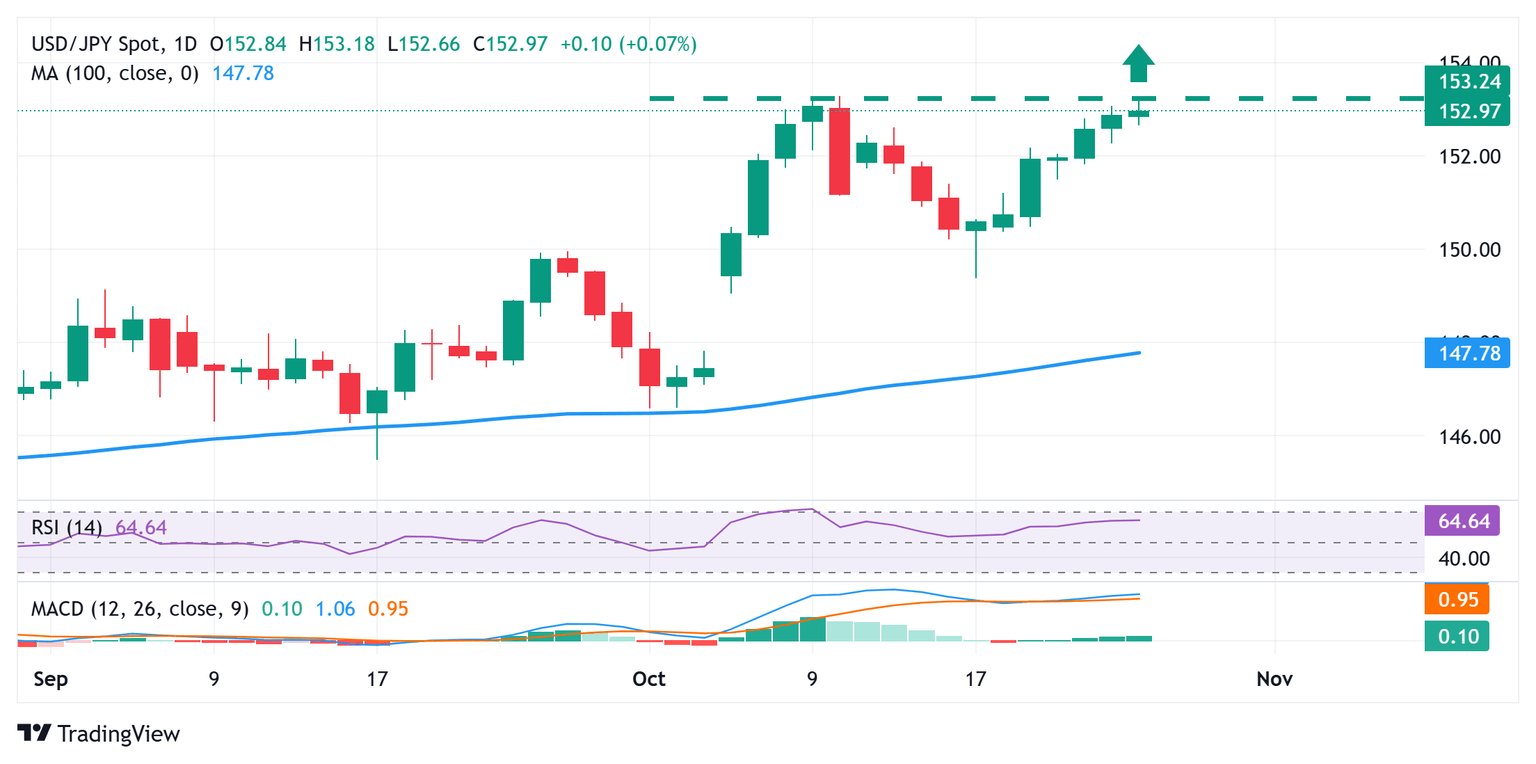
From a technical perspective, some follow-through buying beyond the 153.25-153.30 region, or the highest level since February, touched earlier this month, will be seen as a fresh trigger for the USD/JPY bulls. Given that oscillators on the daily chart have been gaining positive traction and are still away from being in the overbought territory, spot prices might then aim towards reclaiming the 154.00 round figure. The momentum could extend further towards the next relevant hurdle near mid-154.00s en route to the 154.75-154.80 region and the 155.00 psychological mark.
On the flip side, the Asian session low, around the 152.65 zone, could act as an immediate support, below which the USD/JPY pair could slide to the 152.25 intermediate support en route to the 152.00 mark. A convincing break below the latter could negate the positive outlook and prompt some technical selling, paving the way for deeper losses towards the 151.10-151.00 support.
Bank of Japan FAQs
The Bank of Japan (BoJ) is the Japanese central bank, which sets monetary policy in the country. Its mandate is to issue banknotes and carry out currency and monetary control to ensure price stability, which means an inflation target of around 2%.
The Bank of Japan embarked in an ultra-loose monetary policy in 2013 in order to stimulate the economy and fuel inflation amid a low-inflationary environment. The bank’s policy is based on Quantitative and Qualitative Easing (QQE), or printing notes to buy assets such as government or corporate bonds to provide liquidity. In 2016, the bank doubled down on its strategy and further loosened policy by first introducing negative interest rates and then directly controlling the yield of its 10-year government bonds. In March 2024, the BoJ lifted interest rates, effectively retreating from the ultra-loose monetary policy stance.
The Bank’s massive stimulus caused the Yen to depreciate against its main currency peers. This process exacerbated in 2022 and 2023 due to an increasing policy divergence between the Bank of Japan and other main central banks, which opted to increase interest rates sharply to fight decades-high levels of inflation. The BoJ’s policy led to a widening differential with other currencies, dragging down the value of the Yen. This trend partly reversed in 2024, when the BoJ decided to abandon its ultra-loose policy stance.
A weaker Yen and the spike in global energy prices led to an increase in Japanese inflation, which exceeded the BoJ’s 2% target. The prospect of rising salaries in the country – a key element fuelling inflation – also contributed to the move.